The concept of ‘pricing print-on-demand products’ sits at the heart of profitability in today’s digital marketplace. A smart print on demand pricing strategy blends cost awareness with market signals, psychological triggers, and ongoing experimentation to protect margins. Learn how to price POD for profit by breaking down costs, testing price points, and aligning price with perceived value. Understanding POD profit margins helps set targets and informs pricing decisions across channels, bundles, and fulfillment options. With practical calculations and repeatable steps, you can steadily lift margins while remaining competitive in crowded markets.
From an alternate angle, think in terms of cost-to-serve and value signals rather than a fixed sticker price. This framing uses concepts like cost-based budgeting and margin targets to guide decisions behind each item. Tools such as price optimization for print-on-demand items, margin-focused rate setting, and tiered offers can steer pricing across sales channels without sacrificing value. Consider customer willingness to pay, perceived quality, and shipping incentives to shape price while protecting margins. The aim is a balanced mix of cost awareness, market intelligence, and validated experimentation that supports sustainable growth in the POD space.
Foundations of a POD Pricing Strategy: Cost, Value, and Margin Targets
Pricing print-on-demand items starts with a clear view of costs and the margins you need to sustain. By separating fixed costs (like software subscriptions and storefront fees) from variable costs (per‑unit printing, packaging, and shipping), you can model true profitability and map your POD pricing strategy to real outcomes. This foundation helps you avoid price erosion, inconsistent margins, and missed opportunities across channels.
With a defined cost baseline and a target net margin, you can apply a repeatable formula to every product: Price = Total Cost / (1 – Target Margin). This method keeps the math transparent, supports consistent pricing as volumes grow, and makes it easier to defend price decisions to customers and partners. For example, if total cost per unit is $14 and you target 40% margin, the math yields about $23.33, which you would round to a consumer-friendly price like $23.99 or $24.00.
Pricing Print-on-Demand Products: A Formulaic Approach to Profitability
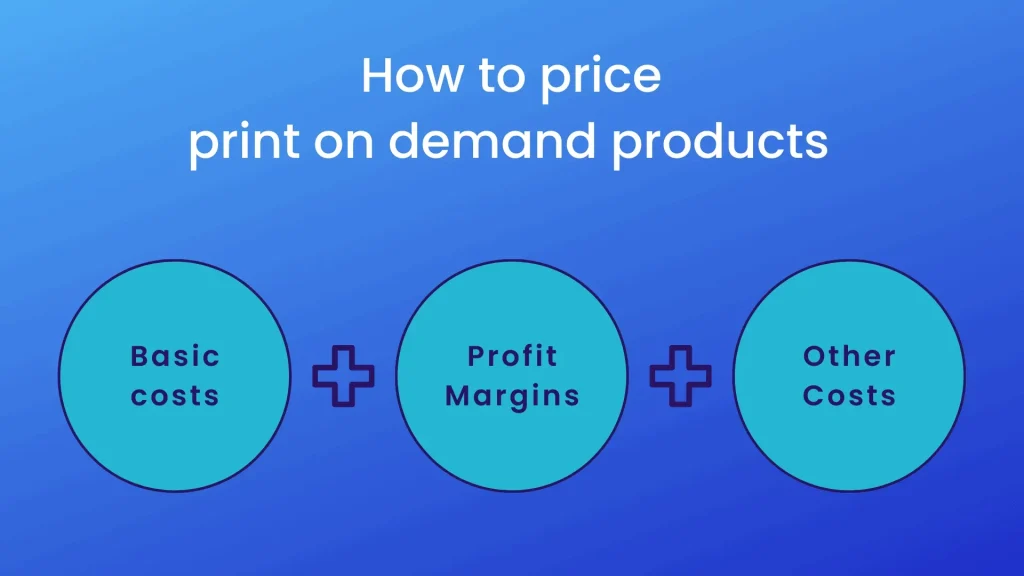
Pricing print-on-demand products requires a full reckoning of all costs: base product, printing or customization fees, fulfillment, packaging, shipping, marketplace commissions, payment processing, taxes, and even depreciation of design licenses. When you know every cost component, you can answer the key question: what price should I charge to reach my target margins? This is the core of a practical print-on-demand pricing strategy and a foundation for sustainable POD pricing strategy.
Beyond costs, apply value cues and psychological pricing. Round numbers such as $19.99 or $24.99, and consider shipping incentives, bundles, or faster fulfillment to justify higher price points. The emphasis is on a sound pricing POD products approach—blending cost awareness with perceived value to improve margins and visibility in competitive marketplaces.
How to Price POD for Profit: A Step-by-Step Method
To price POD for profit, start with a repeatable process: gather all costs, define profit goals, calculate the target price, and consider how shipping is handled. This discipline aligns with a clear POD pricing strategy and helps you scale more predictably as your catalog grows. The steps are designed to be practical for any niche, whether apparel, home goods, or accessories.
Next, ensure consistency across channels. If you must tailor prices by marketplace due to different fees, document the rationale and maintain a consistent value proposition. And remember to test—A/B price experiments or small price moves can reveal elasticity, improving your ability to price POD for profit over time.
Maximizing POD Profit Margins: Shipping, Fees, and Thresholds
Profit margins in POD hinge on more than the base item cost. Pay close attention to shipping costs, processing fees, and platform commissions, and consider how a free-ship threshold affects your math. A well-planned POD pricing strategy uses thresholds to shift some shipping cost into product pricing while preserving attractive margins that appeal to customers and sustain profitability (POD profit margins).
Tiered pricing, bundles, and product variants help raise average order value and protect margins. By offering combinations (e.g., tee plus mug) at a bundled price, you can deliver perceived value while maintaining healthy per-unit margins. This approach also supports more predictable margins across channels and campaigns.
POD Pricing Strategy: Balancing Competition, Value, and Bundles
Pricing strategies for POD revolve around choosing your competitive stance: price to win, price for value, or price as a gateway to bundles and upgrades. Anchor and charm pricing—like $19.99 or $29.99—can influence perception when paired with a clear value proposition. A strong POD pricing strategy blends market context with product differentiation, such as exclusive artwork, premium materials, or faster fulfillment.
To avoid the common pitfalls, set up measurement and tests. Track gross margin, net profit per product, and AOV after pricing changes, and adjust as costs or demand shift. In regions with different currencies or duties, ensure price parity or communicate rational differences clearly to prevent margin erosion. This is how to maintain a resilient pricing POD products approach over time.
Frequently Asked Questions
What is a practical approach to pricing POD products using a pricing POD products strategy to maximize profits?
Start with all per-unit costs and your target margin, then use the price formula: Price = Total Cost / (1 – Target Margin). For example, if Total Cost = 14 and Target Margin = 0.40, price ≈ 23.33, rounded to 23.99 or 24.00. Separate fixed vs. variable costs (e.g., design subscriptions vs. per-unit printing) and account for platform fees and shipping. Use psychological pricing (like 23.99) to boost conversions while maintaining margins.
How can you price POD products to improve POD profit margins?
To protect POD profit margins, calculate all costs per unit (base cost, printing, fulfillment, packaging, shipping, marketplace fees, processing fees, taxes). Set a target net margin and apply the Price = Total Cost / (1 – Target Margin) formula, then test and refine. Consider shipping strategies (free shipping thresholds or included shipping in price) and maintain price parity across sales channels to avoid margin leakage.
In a print on demand pricing strategy, how should you balance costs and value when pricing POD products?
Balance cost-based and value-based elements. Use cost-based pricing to ensure healthy margins and, for premium designs or faster fulfillment, apply value-based pricing to justify higher prices. A solid POD pricing strategy often blends both: start with the cost-based formula, then adjust based on perceived value, audience willingness to pay, and competitive differentiation.
What role do bundles, variants, and price testing play in pricing POD products for profit?
Bundles and product variants can raise average order value and support margins. Price bundles (e.g., tee + mug) at a combined price that’s attractive yet profitable, and offer variants at different price points. Complement these with price testing (A/B tests) to measure impact on conversions, AOV, and margin, adjusting based on data.
What common mispricing mistakes should you avoid in a POD pricing strategy, and how can testing help optimize margins?
Avoid underpricing relative to total costs, ignoring shipping costs, and not testing prices. Inconsistent pricing across markets and underestimating returns can erode margins. Use price experiments and track metrics like gross and net margin, then adjust pricing POD products as costs or demand change to optimize margins.
| Aspect | Key Points |
|---|---|
| Cost Components | Total cost includes base product price, production/printing, fulfillment, shipping, marketplace commissions, payment processing fees, taxes where applicable, and packing. Identify all costs to determine profit. |
| Pricing Formula | Price = Total Cost / (1 – Target Margin). Example: total cost $14; target margin 40% → price ≈ $23.33 (round to $23.99 or $24.00 for psychology). |
| Fixed vs Variable Costs | Fixed costs stay constant per period (e.g., design software, storefront fees); variable costs scale per unit (printing, shipping). As volume grows, you may unlock better rates—reflect this in pricing strategy. |
| Platform Fees & Shipping | Account for marketplace commissions and payment processing fees. Shipping strategies (e.g., free shipping above a threshold) can boost conversions but require careful margin planning. |
| Pricing Strategies | Pricing strategies include: – Competitive pricing: align with competitors but protect margins; differentiate with faster shipping or bundles. – Value-based pricing: price based on perceived value (exclusive artwork, premium materials, better fulfillment). – Tiered pricing and add-ons: variants and bundles to raise AOV. – Anchor/Charm pricing: use 19.99 or 29.99 for perceived value. – Free shipping thresholds: boost cart size while protecting margins. |
| Practical Steps | 1) Gather all costs: base price, printing, fulfillment, packaging, shipping, marketplace commissions, processing fees, taxes, and potential returns. 2) Define profit goals: target net margin (e.g., 20–60%). 3) Calculate target price: Price = Total Cost / (1 – Target Margin); round to consumer-friendly points (e.g., 19.99, 24.99). 4) Consider shipping strategy: include shipping in price or price separately with clear value messaging. 5) Set price across channels: aim for parity or clearly communicate channel differences. 6) Test and optimize: use A/B tests; small changes can matter. 7) Use bundles/variants: create bundles and variants to appeal to segments. 8) Track performance: monitor gross margin, net profit, churn, and seasonality. 9) Communicate value: justify higher prices with design originality, faster fulfillment, or material quality. |
| Common Pitfalls | – Underpricing due to competition: ensure price covers costs and targets margins. – Ignoring shipping costs: shipping can erode margins; include or offset with incentives. – Not testing prices: run experiments to learn elasticity. – Inconsistent pricing across markets: consider currency, duties, taxes. – Overlooking returns/exchanges: build in a cushion for returns. |
| Tools, Data, & Insights | – Price calculators and profitability templates simplify math. – Market/trend data (Google Trends, competitor analysis, platform analytics) help gauge demand and willingness to pay. – Use store analytics to monitor metrics like average order value (AOV), gross margin, and net profit per product to guide pricing decisions. |
| Real-World Scenarios & Calculations | – T-shirt: total cost $9 (base $6, printing $2, packaging $1); target margin 45%; price = 9/(1-0.45)=16.36 → $16.99. If offering free shipping with $3 shipping cost, price may be $19.99 to absorb shipping while preserving margins. – Mug: total cost $6.50 (base $4, printing $1.50, packaging $1); target margin 50%; price = 6.50/(1-0.50)=13.00; common prices: $12.99 or $14.99; bundles (e.g., mug + coaster) can raise AOV. |
Summary
Pricing print-on-demand products is a dynamic discipline that blends math, market insight, and customer psychology. By calculating true per-unit costs, establishing clear profit goals, and applying a thoughtful pricing POD products strategy, you can improve margins while staying competitive. Remember to test, measure, and refine your prices in response to costs, demand, and competition. With disciplined pricing, you’ll create more profitable product lines, increase average order value, and sustain long-term growth in the POD marketplace.