
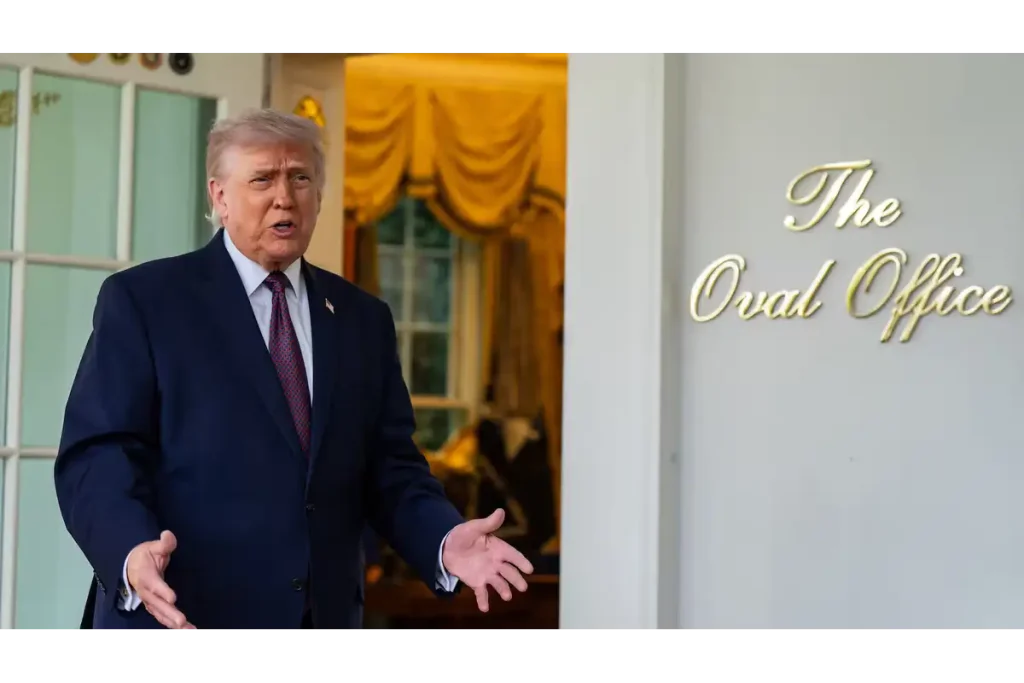
As controversy erupts over the financial terms of the emerging Middle East peace deal, Iran Payout Claims have been forcefully dismissed by U.S. President Donald Trump, who labeled reports of American funding as “Fake News” put out by political rivals. In a series of social media posts, Trump insisted that Washington is not paying Tehran directly to secure the historic ceasefire and nuclear concessions. To stay informed on the shifting geopolitical finances of the White House, explore our detailed coverage in our global finance category.
Table of Contents
The intense debate over the financial mechanics of the treaty has become a focal point of domestic criticism for the Trump administration. Critics have drawn parallels to previous diplomatic deals, prompting a rapid and coordinated response from top White House officials. As negotiators prepare for the formal signing in Geneva this Friday, the administration is making every effort to decouple American tax dollars from the reconstruction plan.
1. Donald Trump Rejects Iran Payout Claims on Truth Social
In a series of characteristic posts on Truth Social, President Trump flatly denied that the United States is sending capital to Tehran as part of the ceasefire negotiations. “Iran has agreed to never have a Nuclear Weapon!” Trump posted, while simultaneously asserting that reports of a massive transfer of American funds were entirely fabricated. By calling the reports a fabrication of political opponents, the President sought to put a swift end to Iran Payout Claims that were beginning to spark a domestic backlash.
According to the original report by the Financial Times, the administration had discussed a multi-billion dollar investment plan as part of the broader diplomatic package. Trump appeared to cite a “300 million” figure in his social media rejection, though the broader policy discussions reference a much larger $300 billion capital framework. The White House has maintained that any financial relief will be strictly conditional upon complete compliance with atomic energy guidelines.
As noted by The Guardian, the administration remains highly sensitive to criticisms of rewarding the Iranian government. During his previous term, Trump frequently targeted prior administrations for releasing frozen assets, making any perception of direct American payouts politically dangerous.
2. JD Vance Explains the $300 Billion Gulf Fund Amid Iran Payout Claims
In a clarifying interview with NBC News, Vice President JD Vance detailed the actual financial architecture being prepared to rebuild Iran’s energy sector. Vance explained that the proposed $300 billion reconstruction fund would be financed entirely by regional allies, specifically the Gulf Coast Coalition (GCC), and private businesses rather than the United States. Vance’s comments were designed to address rising public outrage and clear up Iran Payout Claims by clarifying the actual source of the funds.
“Not a single dime of that money comes from the United States,” Vance told reporters, emphasizing that Gulf Arab nations would only invest if Iran became a stable partner. The vice president added that private companies in South Korea, Japan, Europe, and the U.S. have expressed strong interest in entering the Iranian market once sanctions are legally lifted. This private-equity model is intended to shield Western taxpayers from directly funding the reconstruction.
The strategic involvement of the GCC represents a shift in regional diplomacy. By positioning Arab neighbors as the primary financial backers, the U.S. hopes to bind Iran’s economic future directly to the stability of the Persian Gulf.
3. Performance-Tied Investments Rather Than Iran Payout Claims
A senior U.S. official confirmed that any financial progression within the proposed investment framework is strictly “tied to performance.” The establishment of the investment fund remains entirely contingent on Iran maintaining a 60-day ceasefire, fully reopening the Strait of Hormuz, and allowing International Atomic Energy Agency (IAEA) inspectors back into the country. Crucially, this structural mechanism means that any comparison to unilateral cash transfers or direct Iran Payout Claims is misleading.
Vance also cautioned that while Iranian hardliners might celebrate the potential of economic relief, they must first deliver concrete, verifiable concessions. Should Tehran fail to honor its end of the memorandum of understanding, the United States reserves the right to immediately resume full economic sanctions. This strict conditionality is designed to provide the American public with absolute confidence in the treaty’s terms.
“First, the Iranians do not receive any money simply by signing an agreement or attending a meeting; economic benefits will only flow if they fulfill their obligations,” stated Vice President JD Vance on social media.
4. Comparison: Direct Government Aid vs. Private Rebuilding Fund
This comparative matrix highlights the structural differences between traditional government aid and the private investment model designed to replace direct Iran Payout Claims. The distinction is critical to understanding the administration’s defensive stance.
| Dimension | Direct Government Payout (Objection) | Proposed Gulf-Led Fund (Reality) |
|---|---|---|
| Funding Source | United States Taxpayers | Gulf Coast Coalition (GCC) & Private Corporations |
| Disbursement Model | Direct government-to-government cash transfer | Investment in energy infrastructure via private companies |
| Conditionality | Unconditional or front-loaded release | Strictly “tied to performance” (Ceasefire & IAEA access) |
| Nuclear Oversight | Minimal or deferred inspection regimes | Complete destruction of highly enriched uranium stockpiles |
5. Frequently Asked Questions (FAQ)
What triggered the recent Iran Payout Claims?
The reports of a $300 billion reconstruction fund intended to rebuild Iran’s economy after the conflict surfaced in international media, triggering widespread Iran Payout Claims from critics of the administration.
Is the US taxpayer funding the $300 billion rebuild package to counter Iran Payout Claims?
No, Vice President JD Vance clarified that the proposed fund is financed entirely by Arab Gulf nations and private global corporations, strictly ensuring that no Iran Payout Claims are linked to American tax dollars.
When can Iran access the proposed $300 billion investment fund?
Iran can only access these private corporate investments if it honors its treaty commitments, including maintaining a 60-day ceasefire, dismantling its enriched uranium stockpile, and allowing IAEA inspections in the wake of the highly publicized Iran Payout Claims.